Jump To
Deep Dive

At Arrangr, a scheduling platform for calendar management, meetings, and polls, I led the full product redesign of the web application aimed to reduce friction across the activation funnel and modernize the end-to-end user experience. By addressing high cognitive load in the onboarding flow, disconnected scheduling flows, and an inconsistent UI that was driving early drop-off, I redesigned four core product areas from the ground up. As a result, Arrangr's revenue nearly doubled from $563.3K to $1.1M post-launch, hit 100K+ users, and secured 3 board advisors from Zoom Video Communications Inc.
Role
Lead Product Designer
Team
Project Manager, Frontend Developer
Timeline
Feb - Mar 2023
(3 months)
Core Responsibilities
UX research program design, qualitative data analysis, heuristic evaluation, UX and UI redesign, product strategy
Problem
Users entering Arrangr's web app struggled to understand what the product could do for them or how to complete core tasks. The onboarding flow was long and unclear, scheduling tasks required too many disconnected steps, and inconsistent terminology across flows caused users to abandon key actions mid-task. For a scheduling platform competing in a crowded market, friction at the activation layer was directly limiting user adoption and the product's ability to convert and retain paying customers.
Goals
After completing the user research program and heuristic evaluation, I worked with Arrangr's product team to define priorities and scope the redesign around the highest-impact areas. The high-level goals included:
1
Shorten the onboarding funnel to drive faster time to value
Redesign the onboarding flow to reduce steps, establish a clear first-run experience, and guide users to Arrangr's core value and activation as quickly as possible.
2
Streamline core scheduling flows to reduce drop-off
Redesign the booking, polling, and meeting creation flows to reduce the number of steps required, eliminate confusing terminology, and improve flow continuity.
3
Surface monetization opportunities through better upgrade visibility
Redesign the paywall and Pro feature entry points so users encountered upgrade prompts in context, supporting Arrangr's revenue goals without disrupting the scheduling experience.
4
Unify the UI for a consistent, scalable experience
Replace outdated, inconsistent UI patterns with a modern design system that reduced cognitive load and built user trust across all product surfaces.
Solution
The existing experience had grown inconsistent across features, with each major flow carrying its own UI patterns, terminology, and step counts. I redesigned the onboarding, booking, polling, and meeting flows as a cohesive system, connecting them through shared design patterns, consistent language, and a clearer information hierarchy.

I prioritized reducing the number of required steps and removing any interaction that didn't directly move users toward their first scheduled meeting, poll, or booking page. The activation checklist gave users a tangible measure of progress and a clear reason to return, addressing the drop-off that had been happening before users ever experienced the product's core value.
Before
The onboarding flow presented users with a long, unfocused sequence of steps that offered no clear direction toward Arrangr's core value, leading to early drop-off.
After
The redesigned flow guided new users through a shortened, goal-directed setup culminating in an in-app checklist that drove them toward their first meaningful scheduling action.
Booking pages serve two different users simultaneously: the organizer building the page and the invitee completing the booking. I redesigned the flow to address both contexts, simplifying setup for organizers and reducing friction for invitees. Improving clarity at this stage also directly supported conversion, since booking completion was a key activation signal.
Before
Booking pages were difficult to configure, hard to share, and presented conflicting UI patterns that left both organizers and invitees unclear on next steps.
After
The redesigned booking experience introduced a clean, scalable layout with clear CTAs, reduced configuration steps, and consistent interactions for both sides of the scheduling transaction.
Poll creation had been one of the most-cited friction points in user research: too many steps, a non-intuitive results view, and no obvious path to upgrade for power users. I reduced cognitive and motor load throughout the flow and redesigned the results view to make time selection immediately actionable for the organizer. Contextual upgrade prompts replaced a previously invisible paywall, connecting monetization to the moment users needed Pro features most.
Before
Creating and managing a poll required too many steps, results were difficult to interpret, and Pro feature upgrade paths were invisible to users who needed them.
After
The redesigned polling experience reduced the steps needed to create and manage a poll, surfaced results clearly, and introduced contextual paywall prompts to support upgrade conversion.
Impact

~2x
revenue growth from $563.3K to $1.1M from 2023 to 2024
100K+ users
reached after launching the product updates with 33% YoY average user base growth rate
3
board advisors from Zoom Video Communications Inc. secured post-launch
Deep Dive
Research
Before touching the interface, I designed a qualitative research program to establish a foundation for prioritization. I created the interview guide and questions, trained Arrangr's internal team on how to interview their own customers, and led the synthesis after they completed and logged their sessions. The insights from that analysis shaped the prioritization exercise that defined the redesign scope and budget allocation. With research priorities established, I ran a heuristic evaluation of the existing application that surfaced four recurring themes: aesthetic and minimalist design, cognitive load from competing information, consistency across flows, and visibility of system status.
Affinity mapping to synthesize research findings

Audit
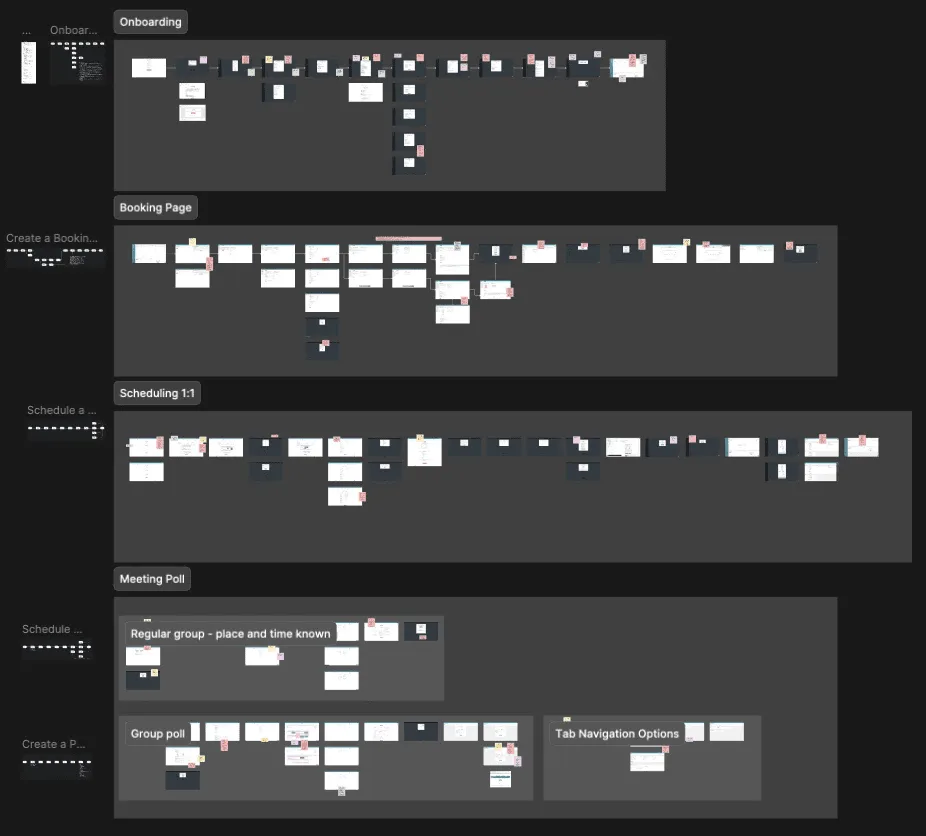
With priorities set from the research and heuristic findings, I mapped the existing user journeys across all four flows to identify where steps could be removed, terminology standardized, and UI patterns unified. Iterative design cycles focused on reducing cognitive and motor load at each key activation touchpoint, with cross-functional reviews used to pressure-test decisions before moving to high-fidelity. The four flows were designed in parallel to ensure a consistent interaction model was in place before any individual feature was finalized.
Audit of existing user flows
Reflection
The three-month timeline required clear prioritization from day one, which is exactly why the research program preceded any design work. Framing that research as a capability-building exercise rather than a one-time deliverable also gave Arrangr the infrastructure to continue learning from their users after the engagement ended. Arrangr ran the redesign as a beta alongside the legacy product before full rollout, which gave the team early signal to refine the experience before committing it to all users. Delivering across four interconnected flows within a tight window meant some decisions were made with incomplete technical context, and the pace made it easy for those gaps to compound quietly.
Reflecting on the process, one factor I wish I would have considered is establishing a more structured communication cadence with Arrangr's lead developer from the start. Coming in as a contractor without historical context on the product, I encountered gaps in technical feasibility and undocumented decisions that affected the design direction in ways a weekly check-in wasn't enough to surface early. More frequent, targeted touchpoints with the dev lead would have caught those constraints sooner and reduced rework downstream. Going forward, I aim to establish a direct technical alignment ritual at the start of every engagement, regardless of timeline or team size.


